How To Tell If Your Suspension Noise Is Coming From the Front or Rear and How to Fix It
August 31, 2026
A suspension noise can travel through the vehicle's body and fool your ears. A clunk that sounds like it is under the driver's seat can actually start at a front control arm. A rattle that seems to come from the cargo area can turn out to be a rear shock mount.
The sound itself still gives us useful information. We pay attention to when it happens, what the steering wheel is doing, whether the brakes are applied, and which wheel is hitting the bump. A good road test narrows the problem down before the vehicle ever goes on the lift.
Front Suspension Noise Often Changes With Steering
The front suspension does more than absorb bumps. It also has to steer, which gives us extra ways to isolate noise.
If you hear a clunk while turning into a driveway, backing out of a parking space, or moving the steering wheel at low speed, we start looking closely at the front. Strut mounts, ball joints, tie rods, control arm bushings, and sway bar links all move as the wheels turn.
A worn strut bearing can pop or bind while steering. A loose sway bar link tends to knock over small, sharp bumps. Control arm bushings usually make a heavier clunk when the suspension shifts forward and backward under braking or acceleration.
What the vehicle is doing when the noise happens is usually more useful than how loud the noise is.
Rear Suspension Noise Shows Up Differently
The rear suspension does not steer on most vehicles, so rear noises tend to show up more during bumps, load changes, or body movement.
A rear shock with a worn mount can knock when the wheel drops into a pothole. Worn sway bar links or bushings can rattle over broken pavement. A damaged spring can clunk when the suspension compresses and releases.
We also check the simple things before condemning suspension parts. A loose spare tire, jack, exhaust hanger, cargo panel, or item rolling around in the trunk can sound almost exactly like a rear suspension problem.
Taking everything loose out of the cargo area before a road test saves a surprising amount of confusion.
The Type of Road Surface Helps Us Find the Source
Different suspension parts react to different kinds of movement. We use that during a road test.
Small repeated bumps tend to expose sway bar links, bushings, and loose hardware. A deeper pothole puts more load into shocks, struts, ball joints, and control arms. A long dip shows us whether the vehicle keeps bouncing after the suspension should have settled.
Useful patterns include:
- Clunk over one sharp bump
- Rattle over rough pavement
- Pop while turning
- Knock while braking
- Creak when entering a driveway
- Repeated bouncing after a dip
We try to reproduce the same sound several times. Once the noise follows a predictable pattern, finding the responsible corner becomes much easier.
Braking and Acceleration Can Expose Worn Bushings
Not every suspension noise requires a pothole.
When you brake, the suspension loads forward. When you accelerate, that load changes direction. Worn control arm bushings can let the wheel move farther than it should during those transitions.
The driver often hears one solid clunk as the brakes are applied, then another as the vehicle starts moving again. We can sometimes feel that movement through the floor or steering wheel as well.
During an inspection, we check the bushings with the suspension loaded in a way that shows actual movement. A bushing can look cracked while sitting on a lift and still be tight, while another can look decent until you apply force and the control arm shifts several millimeters.
Shocks and Struts Are Not Responsible for Every Clunk
Shocks and struts get blamed for many suspension noises simply because they are familiar parts. Worn dampers can make noise, but plenty of clunks come from mounts, links, bushings, springs, or ball joints instead.
A leaking strut that no longer controls movement needs replacement, but a dry strut shouldn't be replaced just because something nearby is knocking.
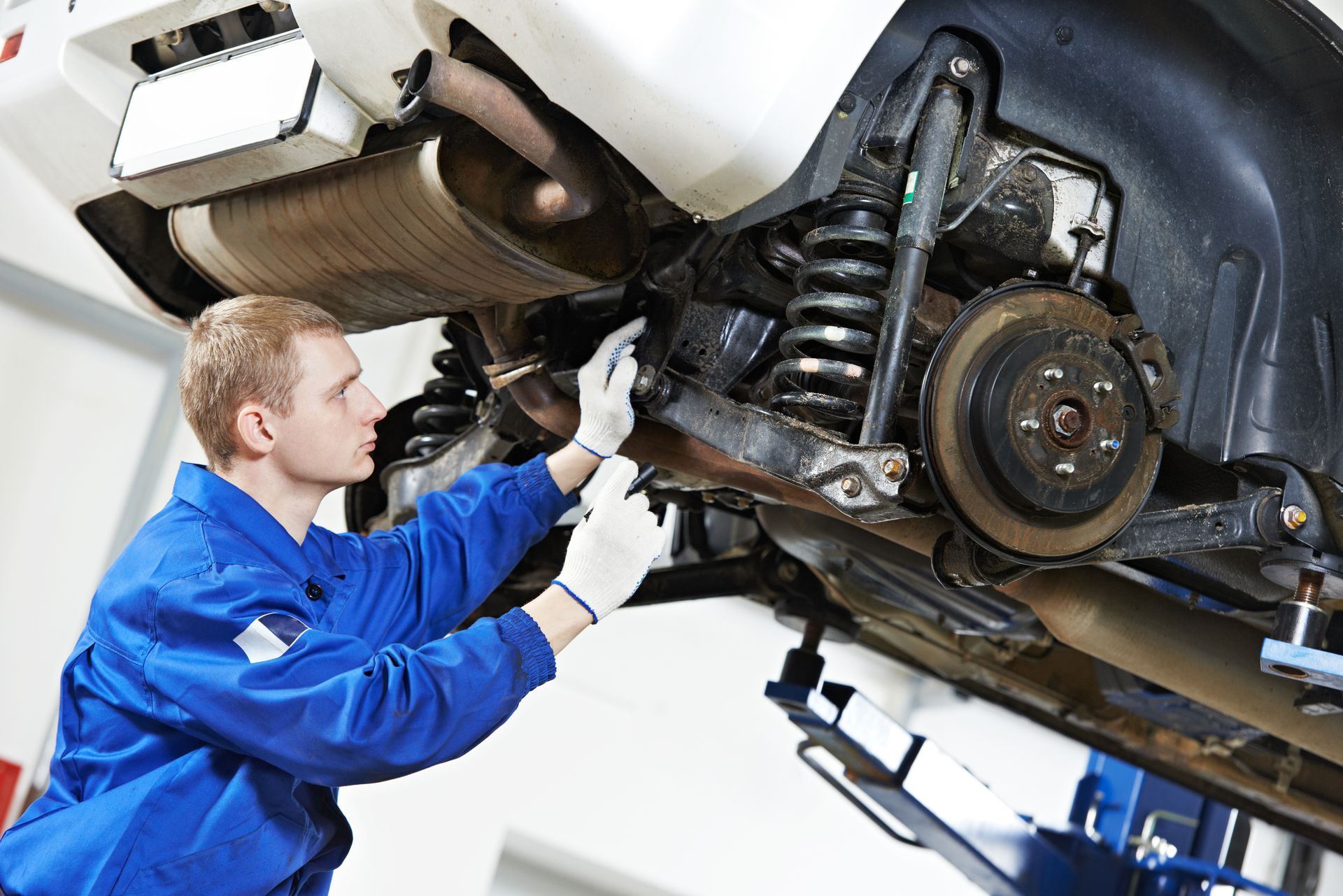
At our shop, we check the complete corner. That includes the upper mount, spring, sway bar connection, control arm, steering joint, wheel bearing, and hardware. If one part is loose, we want to see that movement before recommending the repair.
That approach is especially important when a vehicle has already had shocks or struts replaced, and the original noise never went away.
The Fix Depends on the Part That Is Actually Moving
Suspension noise is a symptom, not a repair description. Once we find the source, the fix becomes much more straightforward.
A worn sway bar link gets replaced. A loose ball joint needs attention before it develops enough play to affect control of the wheel. We repair cracked control arm bushings according to the design, either by replacing the bushing or the complete arm. Broken springs, failed mounts, and worn shocks or struts each have their own repair.
We also check alignment after repairs that change suspension geometry or require removing major locating components.
Regular maintenance helps us spot torn boots, loose joints, leaking dampers, and uneven tire wear before they turn into obvious noises. But once you are already hearing a clunk, pop, or rattle, finding the exact source is better than continuing to drive and hoping it stays the same.
Get Suspension Noise Diagnosis In Spring, TX, With Best Auto Care
If your vehicle is clunking, rattling, popping, or creaking over bumps or turns, Best Auto Care in Spring, TX, can road-test the vehicle and check the front and rear suspension to locate the part creating the noise.